NNF 2018:2520
Hofesh Shechter’s Grand Finale
Norwich Theatre Royal
17/05/18
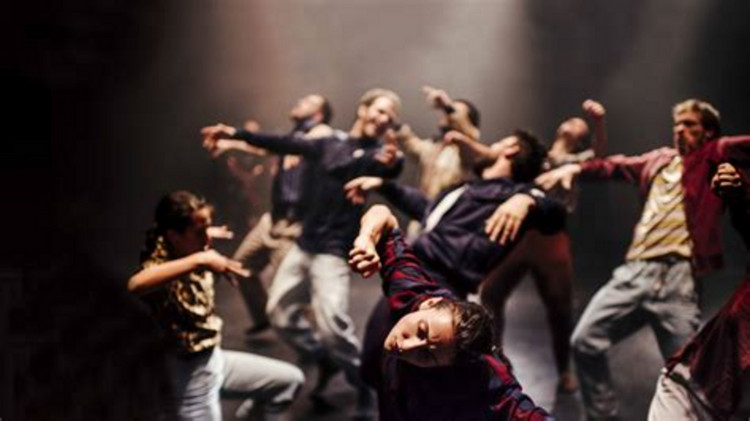
Ten dancers, sexless and loose limbed in shapeless, earth coloured clothes, twisted and turned and writhed and stomped in Hofesh Shechter’s astonishing latest work, offered up his signature mix of dance, music and theatre in a way that instantly identified Grand Finale as something that could have been created by no one else.
It was beautifully staged, working surprisingly well within the proscenium arch of the Theatre Royal. Tom Visser’s superb lighting picked up the dancers as they weaved in and around Tom Scutt’s huge, slate grey, monoliths that loomed over the action with Kubrician portent. The monoliths glided, seemingly effortlessly, into different configurations, creating new spaces into which the dancers could alternately squeeze and spread – a protozoal mass of undulating humanity creating shadowy, flickering images of frenzied movement in the half-light washing over them. Accompanied by Shechter’s own score, a thudding, emphatic, almost tribal noise somewhere between Steve Reich and System 7, the mood was one of disquieting menace. Whether we were watching a representation of post-apocalyptic panic or end of days rapture was never very clear but then perhaps it was both. Oddly reminiscent of Philip Glass’s unpeopled Koyaanisqatsi, this was life out of balance, where bodies are dragged across the stage like corpses, while others stare in anguish, open mouthed in silent mid-scream, before tumbling forward with an artfully faux chaotic momentum.
And all the while, should we doubt the trauma and dislocation that is being explored, the still part of the turning world – a six part band - mournfully played, first front of house, then stage left, then barely visible tucked behind a monolith. Initially their presence seemed inexplicable, until I noticed they were wearing life jackets and realised they were the band from the Titanic, impotently trying to bring calm during the storm. I wonder over the chunkiness of this metaphor, but the use to which the band is put was cunning. From the thumping psy-trance of Shechter’s composition, he impishly gear changed to a Waltz, with dance partners leaden, lifeless bodies grotesquely swung about in classic triple metre, and then shifted again, to Balkan revelry, and all with the band’s able assistance.
It was hugely entertaining to watch, but I can’t help but think that coherence sometimes took second place to variety and spectacle. Shechter has gone on record that he gets bored quite easily, and that restlessness did show. As the undoubted theatrical wonder of soap bubbles drifted down onto the stage, which the dancers moved through and around as children might in snowfall, I couldn’t help but distractedly wonder what it all meant. Hofesh Shechter is a wily and contrary fellow, claiming that it doesn’t really matter what is meant by a particular dance piece, so much as what happens to the audience when they watch it. Yet his earlier works have been so pointedly directed towards a specific intent – be that the Israeli conflict, familial strife, or a disintegrating world – that he knows we are bound to seek meaning beyond the broad and the abstract. It is surely legitimate to take him to task on at least the validity of each scene, if not it’s precise meaning – isn’t it something of a cop out to feebly suggest that meaning is in the eye of the beholder?
The great strength of Shechter as auteur is his singular robust vision, but it is also his greatest weakness – an inability to see where judicious editing would make for a stronger work. Had the piece been honed – with each section stress tested against an abiding intent – the performance could have easily been presented in unbroken form, offering a rising crescendo of exciting, varied movement and dance. I welcomed an interval, with its attendant drink and comfort breaks, but that was largely because I was growing weary at the repetition of motifs and moves, however expertly executed. What it meant was that we had to pick up where we left off, diving back into Shechter’s discordant world with the trepidation that it was going to be more of the same. Ironically, in that final half hour, we did see change and development, and even an attempt at closure, with tender scenes of the dancers huddled in ever more intimate poses, shielding each other from the imagined traumas previously witnessed. It was a shame this couldn’t have been the final act of a single, challenging piece, rather than as the second part of a game of two halves. It would have turned Grand Finale from a fine piece of work into a truly great one.