


Gyða Valtysdóttir - Epicycle
What is so inspiring about Valtýsdottir is her ability to take other peoples music as merely the starting point for what she creates

Gyða Valtysdóttir first rose to prominence as one of the twin singers in an early iteration of the Icelandic band, múm, and I have to confess that prior to booking this particular event, I was woefully ignorant that her solo career had developed so significantly. At the Arts Centre to promote her album ‘Epicycle’ – essentially a collection of covers, albeit a carefully curated collection of famous composers, it was with considerable anticipation an expectorant audience buzzed about, while waiting for something that looked to be a significant departure for the Arts Centre’s usual fare.
Before Gyða Valtýsdottir came to the stage, however, we were treated to a brief and quirky set from her supporting players. Having been to more heavy rock concerts than I care to admit to, a drum solo is something I usually associate with a swift constant break in between songs I actually want to hear, but Sartorius’s percussive workout was something altogether more intriguing. Sandwiched between two relatively melodic refrains from Shahzad Ismaily on guitar (we had been earnestly instructed not to applaud on the changeover) Julian Sartorius produced sounds from his symbols that defied logic and expectation. Even while watching him, it was hard to credit that the otherworldly noises he made were produced without electronic assistance. Gradually building the sound, by juggling components and whacking all manner of things, here were passages reminiscent of like in the repetition, but in his wilder moments he was far closer to the noises made by arch experimental loons, the Bowman brothers. I’m still not sure if it was brilliant or bonkers – perhaps it was both.
Due decorum returned to the stage after the break when Valtýsdottir joined her colleagues, opening her headline set with a haunting and mesmerising interpretation of Hildegard von Bingen’s Ave Generosa (a 12thcentury witch/nunm apparently) which pretty much set the tone for an evening of carefully curated and never less than interesting music from across the ages. Valtýsdottir’s own composition, Rock, immediately followed - a beautiful pastorial piece that (atypically as it turned out) evoked the likes of Butterworth and Vaughan Williams. Thereafter, as if the early pieces were all about settling in, she focused on the work of other composers unified, as she dryly observed, by being dead. Standing for the remainder of the concert, with a cello strapped to her chest like a baby in a papoose, she was from the outset a commanding preens, notwithstanding her tiny, elfin voice that hung spectrally over the music.

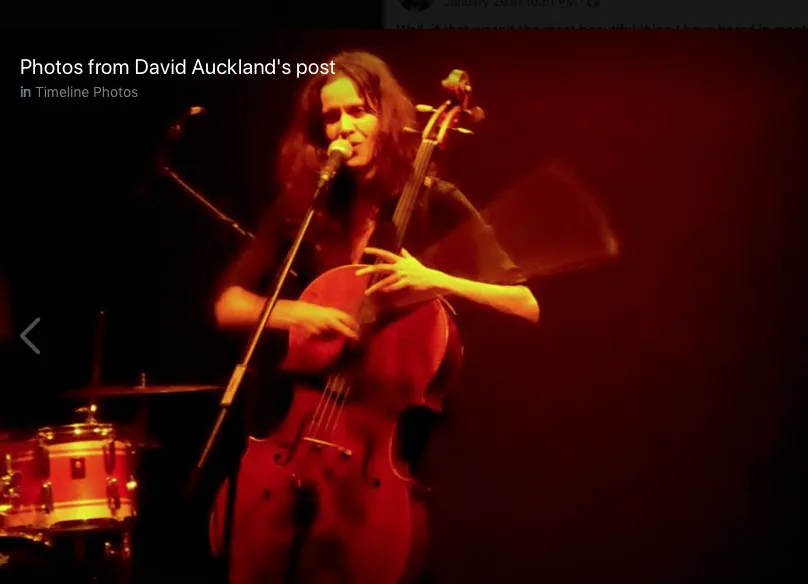
Free to prowl around the stage, as she manhandled her instrument, she worked her way through artists as diverse as Harry Partch and Robert Schumann. What is so inspiring about Valtýsdottir is her ability to take other peoples music as merely the starting point for what she creates. Partch’s composition was originally written for the “harmonic canon”, his own invented microtonal instrument, which you might have thought meant it was off limits, but not so. Apart from a backing track of crystal glasses ringing out – “we couldn’t afford to bring them on tour” - Valtýsdottir fearlessly mines the core musical core from what others might consider to be impenetrable source material. Even more audaciously, we were also presented with a version of Franc Schubert’s Piano Trio Opus 100 …without, as she drily observed, a piano.
In the spirit of full disclosure, I should admit that one of the longest nights of my life was a Olivier Messiaen organ recital, so when his name popped up I wilted in my chair. Yet remarkably, for me at least, Louange à l’Éternité from “Quartet for the End of Time”, proved to be a set highlight. Dreamlike to the point of being almost trippy, I was astonished to learn it was composed while a prisoner of war during WWII. This was just one of many snippets of information Valtýsdottir slipped into what felt like a conversation with the audience, and while I sometimes weary of artists nattering for too long between the music, but here the balance was just right.
A case in point, was Seikilos Epitaph, which we learned is the oldest surviving musical composition in the world, found on a tombstone in Turkey. Valtýsdottir’s performance was, of course, an improvisation based around the melody embedded in the uncovered notation, but it was still a timely reminder that the enjoyment of music stretches back as far as history itself, and will, no doubt, stretch on when we are all gone. What a privilege too sample Gyða Valtýsdottir contribution to that timeline.


