


Peaky Blinders - The Redemption of Thomas Shelby

John Persson
Between 2013 and last year, the exploits of Thomas Shelby and his fictional Birmingham-based gang seemed to capture the imagination of an entire country. In their wake emerged a wave of copycat haircuts, clothing lines, bars and barbers. Nick Cave's 'Red Right Hand' was no longer just a song with a title borrowed from Milton's 'Paradise Lost'. It had become an iconic anthem for a fashionable new tribe. The 'Peaky Blinder' look had arrived.
No surprise, therefore, when the artistic director of Rambert Dance, Benoit Swan Pouffer, searching for inspiration for his company's next project, saw a light shining from this powerful and influential television drama. An approach to original screenwriter Stephen Knight followed, and 'Peaky Blinders: The Redemption of Thomas Shelby' was born.
OK, so it probably didn't happen quite like that, but the result is a brave and challenging production that pushes Rambert's dancers to new limits over the course of its two acts. And yet, this dynamic new show could be at risk of falling between two stools. Will those who loved the television series accept nearly two hours of modern dance with little or no dialogue? Conversely, will devotees of Ballet Rambert be enamoured by the narrative transfer of a populist television show?
The first act opens in traumatic and dramatic style. Moi Tran's set design and Natash Chivers' lighting recreate the grotesqueness of war as bodies emerge from tunnels and trenches, only to hear Benjamin Zephaniah's recorded voice declaring that, as “young men of the tunnelling brigade, you are all dead, not because your bodies were buried, but because you are dead inside”.
'The Redemption of Thomas Shelby' is billed as a prequel to the events of the television series, yet we are immediately transported into the cacophonous steampunk hammerings of a Birmingham steel foundry, and plunged directly into the events of Season One, and of post-war Shelby life. We are introduced to Polly (Simone Damberg Würtz) and Ada (Adél Bàlint), and to the world of horse racing, gambling and illegal off-course betting. The merry-go-round horses are a neat touch, adding an air of surreality to an emerging post-war gang culture – a world of fear, violence and undeclared cash. It is at a lavish night club where Thomas Shelby (Guillaume Quéau) first meets Grace (Naya Lovell). Their passionate duet is followed by a wedding, and then betrayal and murder, and brings Act I to its dramatic conclusion.
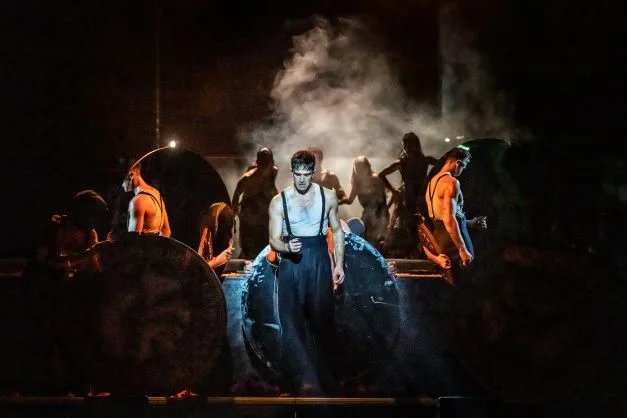
The esoteric meanderings of Act 2 are more nebulous, and perhaps more unfocused. A chilling descent into Shelby's post-bereavement world of opium addiction and grief ensues, only for him to be saved by the interventions of brother Arthur (Dylan Tedaldi) and Polly. A ghostly manifestation of Grace precedes the arrival of a phantom army of soldiers, and a reprise of 'Red Right Hand' from the band. And Benjamin Zephaniah's voice is there again, reminding us that Thomas Shelby was forced to decide whether to live or whether to die, and that he chose to live.
And yet, the entire work is beautifully executed – the dancers are absolutely on-point with every tightly-choreographed twist, turn and stretch. Their syncopated movements are taut with visceral physicality, and yet are beautifully balanced with precision, grace and elegance. Even a simple walk across the stage is performed with poise and purpose. And Musa Motha, as Barney, is absolutely, gob-smackingly extraordinary, acclomplishing dance moves which I, as an able-bodied biped, could only dream of.
And yet, the ultimate question remains. Does 'Peaky Blinders – The Redemption of Thomas Shelby' successfully build that bridge between populist television and modern dance? Not completely, to be being honest, but full marks for a brave effort. The sets, the lighting, and the live band (Roman GianArthur's score is augmented with tracks from the likes of Radiohead, Laua Mvula and Anna Calvi, all from the television soundtrack) are all great. The costumes (designed by Richard Gellar) capture the essence of 1920's post-war austerity and yet still give the dancers full freedom of movement. And, of course, the dancers themselves. Every performance is totally on-the-money.
The main disappointment then, lies within the the narrative construct, turning out to be neither prequel nor sequel. Instead, it seeks its own separate pathway, deviating from the original plotlines in order to serve its own philosophical posturings. This may disappoint or confuse some fans of the original television series, or even come across as mildly pretentious.
But me? I bloody loved it. Go see it. Do what I do, Do what Thomas Shelby did, and choose life. And enjoy every minute of it.
By order of the Peaky Blinders.


