


Private Lives
As a classic drama about love, lust and conflict, 'Private Lives' still takes some beating.

Theatre Royal
It is hard to believe that it is ninety years since Noël Coward and Gertrude Lawrence opened on the New York stage in the original production of Private Lives. Since then, it has been filmed for the cinema (once, in 1931), adapted for UK television twice (most recently in 1976 with Alec McCowen and Penelope Keith), and broadcast twice on BBC Radio 4 (including a wonderful version in 2010 with Helena Bonham Carter as Amanda, and Bill Nighy as Elyot).
And yet, as I sit in Norwich Theatre Royal, staring at a huge two-storey hotel façade with adjacent terrace balconies, I realy feel as though I am visiting a familiar old friend for this, the inaugural production from The Nigel Havers Theatre Company.
The set seems enormous, and the soft brown and cream pastels ooze 1930's Deauville charm. But the action is focused upon the two adjacent balconies. We are introduced first to Elyot and Sybil, and Nigel Havers receives a welcoming round of applause as he walks onto the balcony. Such is the warmth and affection in which he is held by this Norwich audience. Elyot and Sybil are on their honeymoon, Elyot having divorced his first wife Amanda five years earlier.
In a plot twist more akin to farce than comedy of manners, Amanda (played by Patricia Hodge – cue another entrance and another round of applause) has also remarried, and is staying in the very next room with her new husband Victor. As the centimes drop, we witness enraged exits from both Sybil and Victor, the reunification of Amanda and Elyot, and an impromptu decision for the two of them to run off to Amanda's flat in Paris.
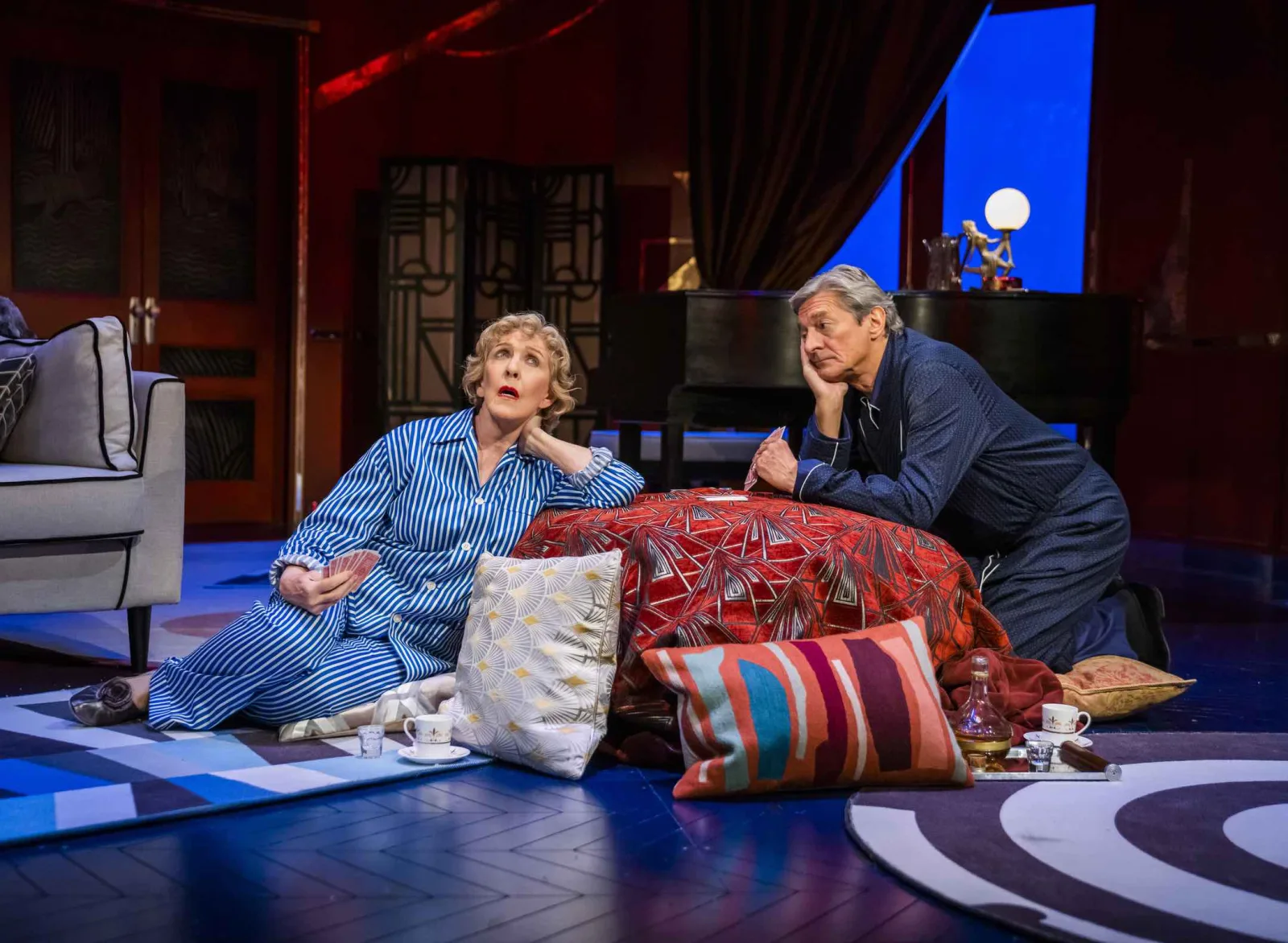
Acts Two and Three take place in the Parisian apartment, and the stage has been transformed into a rich interior of red and gold. Arguments and bickering rapidly resume, and the use of safe words 'Solonon Isaacs' introduced to allow time-outs. Act Two is probably where much of the crucial dialogue occurs, and yet this is where the action suffers from a slight loss of pace. In contrast, the arrival of Sybil and Victor in Act Three re-energises the action, with verbal sparrings gallantly interjected by Aïcha Kossoko as French maid Louise, and leading to the play's tipping point and dramatic conclusion.
The pairing of Hodge and Havers is a delight, and a genuine crowd pleaser. Their clipped vowels and perfect enunciation ensure that every line and each nuanced barb is delivered with period precision, and not a punchline or witticism is wasted. (Although the audience's enthusiasm to laugh at the mere mention of Norfolk in Act One is a touch premature, and one of the play's best lines goes almost unnoticed). The script has been tweaked to remove a few of Coward's more mysogenistic lines, but is otherwise true to its 1930's origins. Dugald Bruce-Lockhart is perhaps a touch one-dimensional in his portrayal of Victor, but is more than compsensated for by Natalie Walter, who is wonderfully charismatic as Sybil.
As a classic drama about love, lust and conflict, 'Private Lives' still takes some beating. Filled with old-fashioned, and sometimes redundant, attitudes around loyalty, prejudice and guilt, Coward's words still chime with modern-day audiences, and this production crafts and presents them with style and with substance. We come away with a new appreciation that very few people are completely normal, especially deep down in their 'Private Lives'.


