


Private Peaceful
“We are spared the graphic horrors, but the message hits its target with dramatic precision”

Theatre Royal
War is in the news again, this time as we follow the Russian invasion of Ukraine. This production of Michael Morpurgo's Private Peaceful began its tour at Nottingham Playhouse just days before that conflict began. Almost four months later, the fighting continues, and as the show arrives at Norwich Theatre Royal, the unintended irony of its timing cannot be lost on the audiences. With collection buckets at every performance Norwich Theatre audiences have, since February, generously raised over £33,000 for the DEC Ukraine Humanitarian Appeal and, as a Theatre of Sanctuary, Norwich Theatre is, this week, donatng another 50p from every Private Peaceful ticket sold.
From the farms of rural Devon to the battlefields of Northern France, Private Peaceful recounts the story of Tommo Peaceful, a young country lad fighting a war that he does not understand, for officers that he cannot respect. Adapted by Simon Reade from Michael Morpurgo's acclaimed novel, this stage version by Nottingham Playhouse is presented as a series of flashbacks and memories, all recalled by Tommo as he stays awake ahead of execution by firing squad in the morning. 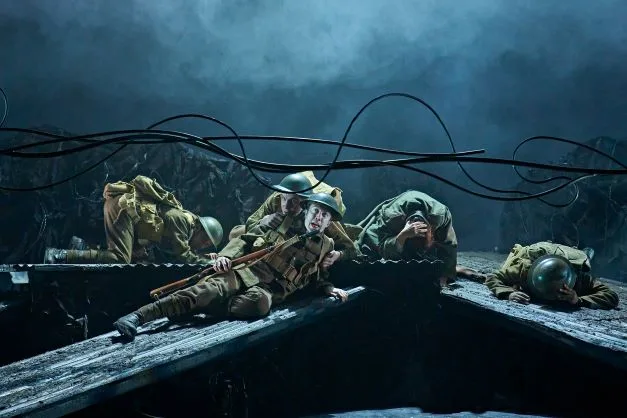
With a single clever set designed by Lucy Sierra we are carried from the peaceful idyll of rural England to the mud and trenches of the First World War. Thanks to Matt Haskin's lighting design and a few well-placed props, fresh blues and greens of the English countryside transport us to the muddy browns and blacks of the Western Front. The tranquil stream and bridge that provide the setting for carefree skinny-dipping become, in the blink of an eye, a desolate network of trenches, boardwalks and shell craters. As Tommo’s final hours tick away he recalls key moments from his childhood – his father being killed by a falling tree, attending school with older brother Charlie, meeting Molly, the girl they both fall in love with, and the struggles of being poor and beholden to a cruel landlord. We meet their hard-working mother, and Grandma Wolf, and third brother Big Joe. We sense the strong bond of loyalty that exists between the brothers, bonds that survived their love for the same girl but are brought to a tragic end when Tommo refuses to leave his injured brother on the battlefield, and is court-martialled for cowardice, and ultimately executed.
Morpurgo’s story was written for children, and there are many young people in the audience tonight. Yet, in Reade’s adaptation, and with Elle While’s sensitive direction, it is the human tragedy of war that is conveyed so starkly and effectively. We are spared the graphic horrors, but the message hits its target with dramatic precision.
Daniel Rainford's demanding performance as Tommo is remarkable – he is on stage for almost the entire show, and takes us on a roller-coaster of emotions – guilt, love, fear and anger, delivered with a visceral sense of helplessness and resignation. Daniel Boyd is everything that you would want older brother Charlie to be – caring, confident, and assertive, though his ultimate fate during the final 'big push' remains left to our imagination.

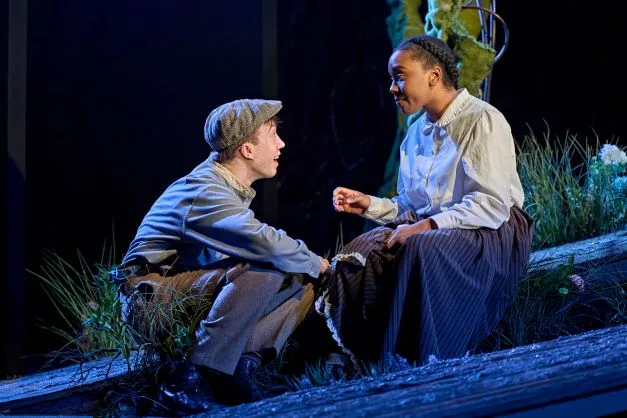
The other five actors are presented with the chameleon-like challenges of portraying an entire supporting cast of characters. Liyah Summers is delightful as Molly, but also inhabits at least four other roles. John Dougall is father, James Peaceful, but also fills another eight pairs of boots (including those of Grandma Wolf!). Gallant, long-suffering mother, Hazel Peaceful, is played by Emma Manton, but also appears as everything from an army chaplain to a captured German soldier. Robert Ewens is excellent as Big Joe, but also appears in the battle scenes. And last, but not least, Tom Kanji makes an excellent reconnaissance pilot, Doctor, Major and at least four other military-based characters. It is a remarkable ensemble performance from the entire cast.
Whilst war is never an attractive subject for entertainment, this stage adaptation tackles the human issues of Morpurgo's narrative with humanity and compassion. We are left with a sense of the desperation of life in the trenches, but also of the domestic hardships of life in Edwardian England for the rural working classes. And, above all, it is a story of redemption, love, and duty.


