


Rough Crossing
Stoppard’s text constantly reminds us that this is a play about a play, poking fun at theatrical convention, making a virtue of its shortcomings, and openly taking the mickey out of anyone investing too much energy into proselytising art

Tom Stoppard has long been regarded as one of the greatest, and most influential, playwrights of the 20thcentury, and while he continues to produce memorable and provocative work – most notably returning to the National in 2015 with the Hard Problem – it is his prolific output between the sixties and nineties for which she is best known. Sandwiched in between the game changing absurdism of Rosencrantz and Guildenstern Are Dead, and the towering intellect of Arcadia, there has been all manner of experimentation and innovation, but sometimes he has aspired to nothing grander than a bit of fun. Rough Crossing is a case in point, a frothy farce brimming with jokes and general silliness, yet infused with Stoppard’s signature theatricality and complex wordplay. Neither contemporary theatre nor period piece, the play occupies an uneasy place in Stoppard’s canon. It is undoubtedly a lesser work, and to that extent a surprising choice for revival, but there is still much to enjoy here, not least when performed with such a strong, committed cast.
Set design might seem an odd place to start when examining a production, but Colin Richman’s beautiful art deco evocation of SS Italian Castle offers up such a stunning opening to the play that it warrants lavish praise. It was a shame that stage logistics necessitated the ship being on show as seats were taken - a grand reveal from behind a curtain would have been so much more impactful. Constructed on two levels, Richman set cleverly facilitated the central conceit of the performance – that of an overheard conversation which might compromise a romance - with imagination and economy. The conversation, albeit a tad queasy and uncomfortable to our post-millennial ears, was delivered with brio and knockabout good humour by a vampish Issy Van Randwyck and a comically unctuous Simon Dutton. When not listening to his fiancé’s dalliance, Rob Ostlere did his best with a somewhat laboured speech impediment gag, straight out of the Two Ronnies, while Matthew Cole made the most of his underwritten theatre producer. The plot, such as it was, then reliably unravelled in an agreeably amusing way, and though it produced more chuckles than laughs, and little in the way of surprises, the plot wasn’t really what the play was all about. Indeed, the two leads, going about their business in the foreground, concerned themselves mostly with the serving of cognac. John Partridge was excellent as the world-weary playwright, whose cunning plan might just save an otherwise doomed romance, and therefore his play’s debut performance, but who spent most of his energy trying to wrestle a cognac from Charlie Stemp. Stemp was brilliant as a waiter that steals both scenes and drinks, and commanded the attention of the audience every time he appeared. Although his character was notionally supporting, the stage always felt a little empty without him.
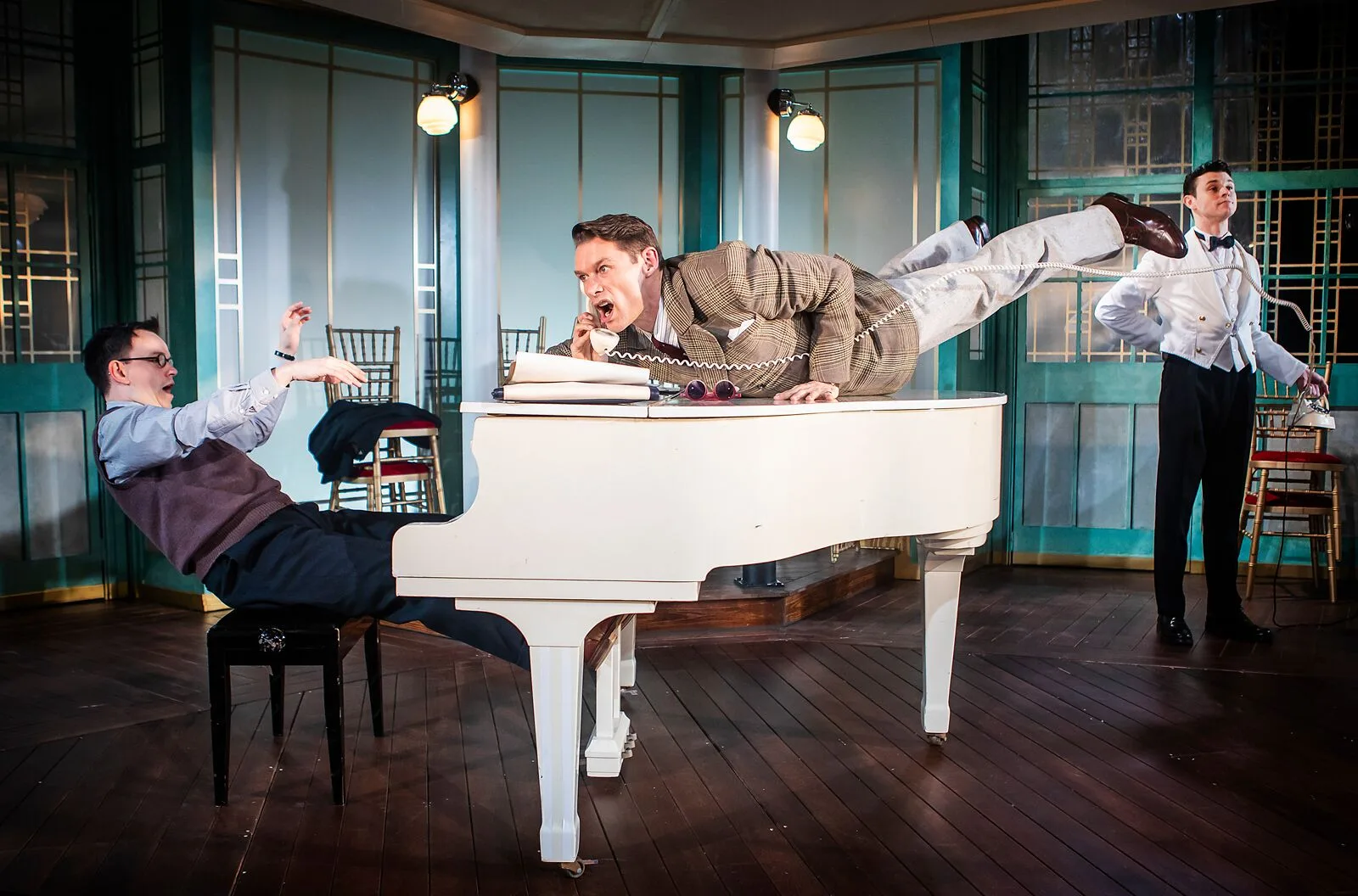
When a cast tries this hard the enthusiasm is infectious, and notwithstanding material that was at times undeniably laboured, they managed to draw both laughter and applause from an audience determined to have a good time. Credit is also due to Rachel Kavanaugh brisk direction, ably papering over the cracks with all sorts of comedy business. I particularly enjoyed noting that Stemp, who had been unsteady on his feet throughout, managing to stand stock still during a storm, while the rest of the cast rolled around like an episode of Star Trek. It bore no relation to the plot, was perhaps not even noticed by many, but it was a nice touch, and typical of the production that had been marshalled with care and attention to detail.
The play didn’t really go anywhere – its failure to satisfactorily resolve is a criticism that has dogged it since inception – but it’s not as if we weren’t tipped off in the opening few minutes. The play constantly talks about itself, is self-referentially knowing and thoroughly meta from the start. Stoppard’s text constantly reminds us that this is a play about a play, poking fun at theatrical convention, making a virtue of its shortcomings, and openly taking the mickey out of anyone investing too much energy into proselytising art. Whether you find the intricacies of Stoppard’s subtext thrillingly inventive or achingly tiresome largely depends on your opinion of his work as a whole. There is no doubt that he’s done this sort of thing with greater subtly and in service to a greater purpose, but it was fascinating nonetheless, to see his direction of travel back in the day. The fact that it took place on the lumbering leviathan of an aged steam liner is, I think, an irony he would appreciate.


