


Spooky Kid Productions

A pantomime based on Jack The Ripper’s story. The Beadledook, about a midnight ceremony that conjures up the mischievous spirit of Jeremy Beadle. Aladdin And His Magic Tramp. All shows written and brought to life by Norwich’s Spooky Kid Productions, who have been working hard to entertain you for the past eight years. Their brand new work Zombie: A Musical is at the Playhouse this month, so I spoke to co-creator Jim Blythe about controversy, Edinburgh Festival and who makes him laugh.
Spooky Kid Productions has been going since 2009. How did it start?
I forget exactly - I expect it was the result of a fever. What I do recall was that having spent a lot of years writing material, and a lot of years performing other people’s, it seemed to make sense to combine the two and start performing original material. I wanted to start something which crossed any creative medium and so a non-commercial production company felt like the right way to go.
What did you want to achieve with it?
Firstly, to have fun. I like fun. It’s on my CV under general interests. But importantly it’s always been about giving a platform to new talent. Spooky Kid only uses new, unpublished writers, whether that’s for stage, screen or audio material. We give people their first stab at directing or producing shows, or doing their first stand up or music gigs. The first few years were a bit chaotic and we would try absolutely anything provided it was creative and new until 2013, when we decided we would make it exclusively about creating new comedy.
How did you find all your players?
I hung around the seediest bars in the city in the early hours of the morning and saw who entertained me. Some have been performing for years and some have never done it before but fancy giving it a go. Importantly, they’re all nice, genuine people – we don’t indulge any egos. Other than mine, obviously.
You’ve had several shows at the Puppet Theatre and also filmed some shorts. What have you learnt to do better or more efficiently over the years?
I’ve found quite a few ways not to make a film which is a lot more useful than it sounds. Because we write our own stuff we’ve learned the importance of not writing ourselves into positions where something is ludicrously expensive or complicated to achieve. In short, we’ve learned to keep it simple and let the humour of the material come through. We’re not big on lavish sets or special effects.
You took your show No Tomatoes to the Edinburgh Festival in 2010. How did you find the experience?
No Tomatoes was one of two Edinburgh shows we did and it was the most successful. Edinburgh is the most insane and intense experience, living and working with a small group of people for a few weeks in your own, strange little Edinburgh bubble. It then feels very weird trying to come back to real life again afterwards. I remember walking a lot, handing out thousands of flyers and talking myself hoarse telling people about the show. Then performing for an hour before going out to see some shows and have a few drinks. Inevitably this would lead to going to sleep at some point in the morning and then waking up feeling dazed and confused before doing it again. It’s a lot of fun.
Jack The Ripper The Panto was extremely popular despite some initial opinions being aired that people thought it wasn’t a suitable topic for a funny show. Did you anticipate these issues and how did you find dealing with it?
The issue of it being a suitable topic is an interesting one. If you’ve never seen the show or read the script, are you in any position to say what the topic actually is? The show is a satire that highlights the hypocrisy of a society that wrings its hands over dreadful things that happen to our most vulnerable people, whilst doing nothing at all to try to treat the problems. And that’s still very relevant today, never mind 1888. Humour has always had a place in shining a light on controversial topics and when you pick one there’s always going to be a danger that people will misconstrue what it is you’re doing. After four runs of performances between 2009 and 2015 we’ve never had a single complaint from the many people who have seen the show. The Playhouse were amazingly supportive too and I thank them for that.
<iframe src="//www.youtube.com/embed/bVi6AsSfwAw" width="560" height="315" frameborder="0" allowfullscreen="allowfullscreen"></iframe>
You created an updated Shakespeare with Macbeth Ate My Hamster, and a family friendly show, Aladdin And His Magic Tramp. Do you like to have the challenge of rewriting classics?
Graham (my co-writer) and I enjoy mixing the well known with the absurd. Neither of us is keen on pantomime so we’re always happy to satirise the genre. Change ‘lamp’ to ‘tramp’ and you have a great new twist on Aladdin. Macbeth, on the other hand, is my absolute favourite Shakespeare but at that time I was getting my knickers in a twist about lazy adaptations that claimed to be modern takes on his plays but appeared to just be ways of staging Shakespeare without having to bother hiring the costumes. I figured that if you’re going to do a modern spin on Shakespeare then you should do it properly. Macbeth Ate My Hamster was faithful to the original but it became a black comedy set in a local radio station. So it’s less the challenge of rewriting classics and more having something that audiences are familiar with and making it new and unfamiliar to them that appeals.
Most of your shows have been at Norwich Puppet Theatre and the Playhouse. Do you think that Norwich is well served for venues?
Yes, but that said we don’t always find it easy to find places to perform. The Maddermarket is a great venue but with their house group it is occupied half the year so getting booked in there can be tricky. The Playhouse gets booked up over a year in advance in some cases. The Puppet Theatre is lovely but the stage is very small and, inevitably, people expect to see puppet shows there and aren’t looking out for live shows. That leaves the Garage which I like very much but not much else. I would love to see pub theatre become more of thing in Norwich; it’s so popular in other parts of the country. We ran a short season of festival length plays in the Hog in Armour a few years back and it was great fun. If I could find a pub that’s interested and has a decent sized room we could use I’d start pretty much straight away. If there’s any publicans reading this who want a new way to bring an audience into your pub then contact me. Seriously, I would love to get that started.
<iframe src="//www.youtube.com/embed/lK1F-bIgA5w" width="560" height="315" frameborder="0" allowfullscreen="allowfullscreen"></iframe>
You’ve run two Comedy Shorts competition where Norfolk-based writers are asked to submit 20 minute comedy scripts. The best four are performed at the Maddermarket and then the best one is announced on the night. How do you find the quality of the material that has been submitted?

It’s a mixed bag but at its best it’s great. A chap called James MacDonald (Outline’s Big Eat Out writer!) reached both finals and won the second year and his scripts are really, really funny. I know he’s won another competition at the Maddermarket since so keep an eye out for him. I had some scripts submitted from young writers who showed enormous promise and I really hope they’ve carried on writing. I would have kept Shorts running forever but we couldn’t seem to attract much of an audience along which is a great shame.
Your brand new show, coming to The Playhouse this month is Zombie: A Musical. What’s the gist?
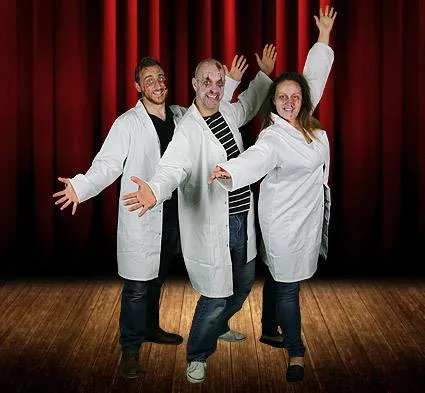
It’s a black comedy and a satire, this time attacking corporate greed and corner cutting. The idea is that a biochemical corporation called Avida are demonstrating their work on the prolonging of human life when things go wrong. Zombies appear, songs are sung, dances are danced, people get killed and hopefully everyone has a jolly good laugh. We’ve written nine new songs for it, we’re working with the Michala Jane School of Dance because we’re not the best dancers in the world and we’re trying to create a different experience for the audience to the one that they experienced last time we were at the Playhouse. It should be a lot of fun.
Who makes you laugh?
Stand up wise Stewart Lee, Mark Watson, Reginald D Hunter and Rhod Gilbert are all current favourites, and I love the early Eddie Izzard gigs. I’ll laugh at pretty much anything by Graham Linehan or Douglas Adams. Inside Number 9 is my favourite thing on the TV right now, so clever and funny. Steve Pemberton and Reece Shearsmith are brilliant.
<iframe src="//www.youtube.com/embed/OaMnq9j9I0I" width="560" height="315" frameborder="0" allowfullscreen="allowfullscreen"></iframe>
How do you tackling the writing process? For example, how long would a show take to write?
The longest part is getting started. Zombie: A Musical was just an idea for about two or three years with a two-page synopsis to back it up which neither Graham or I were totally happy with. Once we actually wrapped our heads around the idea, the first draft took around two months to write I think. We used to write pretty much everything together but now we’re finding it quicker for one of us to write a version, which the other then edits. So I wrote a first draft of Zombie and sent it to Graham. He made a number of amendments and sent it back. Then we got together and tidied it up until we had a pretty much finished version. Then we argued over the last few bits until we had a rehearsal script. Even now I’m not sure it’s finished. After every staging of Jack The Ripper we re-wrote parts of it – the 2015 version is really quite different to the 2009 one – based on cast and audience reaction.
Who creates your costumes, music and sets?
Costumes we beg and borrow from everywhere and anywhere but there’s a very lovely lady called Maggie who has provided the majority of our costumes since 2009. We have Tym Dartnall as our resident musical genius and he has the unenviable task of taking mine and Graham’s dreadful singing and trying to turn it into a melody, and from there, into songs. As the years have gone on he’s got better at working out that me making the sound of a dying giraffe is actually C minor and so on. As to sets, we don’t really use them. Our house style is black box with furniture which started off as a practical necessity – we had nowhere to build or store sets and no time to build them at the theatres so we had to do without. And it just seemed to fit our style so we’ve carried on that way since.
What’s the most challenging thing about running a performance group as a part time thing?
Unsurprisingly the answer is time. As the shows get closer and there’s a lot of stuff to pull together and publicity stuff to do and cast to be looked after it gets very, very tiring. Musicals and pantomimes especially.
Have you had a chance to work with any other drama or comedy groups in Norwich?
I was a member of Rackheath Players for quite a few years in my younger days, and I’ve worked with St Andrews Players, Sprowston and Great Hall. But Spooky Kid takes up a lot of time so I don’t even get the time to go and see much of what other groups are doing, never mind to work with them. Graham and I have been working on the BBC Norfolk New Comedy Show writing and performing sketches and stand up which has been a lot of fun and has given us a chance to work with some brilliantly talented local performers.
<iframe src="//www.youtube.com/embed/M03rrgzQLXA" width="560" height="315" frameborder="0" allowfullscreen="allowfullscreen"></iframe>
What advice would you give to anyone who’d like to start writing plays and/or comedy?
Write. Even when you don’t have any ideas or it gets hard, just keep on writing. A huge amount of it might turn out to be utter rubbish but there will be good ideas, good lines or good characters that come out of it. No Tomatoes came out of an idea of a two minute conversation in a pub and just grew. Most first drafts really aren’t that great but it’s much easier to write something funny when you have some material to work with. And, in my experience, writing’s a habit. The more I write the easier I find it and the better I do it. Oh and always remember that a first draft is just that, it’s not a finished product. Once it’s finished, get some friends to read it so you can hear it. Get feedback on it. Once you think it’s good enough, try performing it and then go back and rewrite it again. Write what you want to write, not what other people think you should, especially if you’re writing comedy. If you don’t think something’s funny then it probably isn’t. And don’t be too precious about your material – if feedback from others is that it needs rewriting then they might well be right.
What can we expect from going to see a Spooky Kid Productions show?
You might have gathered by now that it’s usually dark comedy - so you can expect to laugh. We always aim our material at an adult audience so expect adult themes and language. The humour is usually absurd but hopefully makes sense in its own twisted way. We agonise over plot holes and try not to leave any. And typically our audiences aren’t traditional theatre audiences; they’re drunks who have taken a night off from the pub to drink in a theatre bar instead.
See Zombie: A Musical at Norwich Playhouse on 21st and 22nd of April. Find out more at norwichplayhouse.co.uk


